

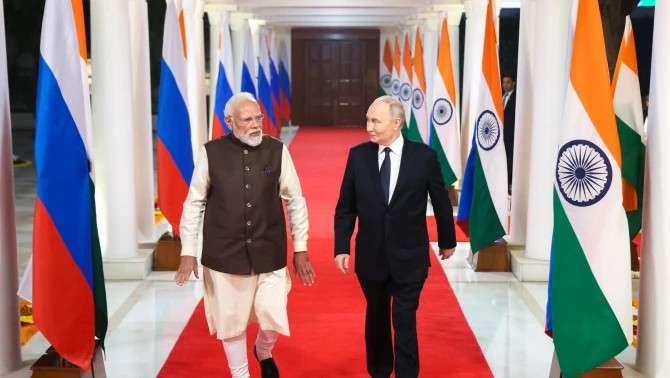
The latest Modi-Putin summit in New Delhi marks a calibrated deepening of India-Russia economic engagement, reflecting New Delhi’s push for strategic autonomy amid shifting global alignments. At the centre of the talks was an ambitious roadmap to raise bilateral trade to $100 billion by 2030, signalling India’s intent to institutionalise long-term cooperation despite geopolitical pressure from Western partners.
A key highlight was Russia’s assurance of uninterrupted energy supplies, underscoring India’s growing dependence on discounted Russian crude to manage inflation and secure energy stability. This move also strengthens Moscow’s pivot toward Asian markets as it counters Western sanctions. Beyond hydrocarbons, the two sides expanded cooperation across defence co-production, civil nuclear projects, fertilizers, shipping corridors, labour mobility, and high-technology manufacturing, reflecting an attempt to rebalance a trade relationship historically skewed in Russia’s favour.
Strategically, the summit reiterates India’s multi-alignment doctrine: maintaining deep defence ties with Russia while simultaneously advancing partnerships with the US, EU, and Indo-Pacific allies. Fast-tracking negotiations on a Free Trade Agreement with the Eurasian Economic Union (EAEU) suggests India is exploring diversified export avenues to reduce supply-chain vulnerabilities.
The talks also had political undertones, projecting resilience in a relationship tested by the Ukraine conflict and global pressure. By reinforcing cooperation at a time of intense geopolitical contestation, Modi and Putin signalled continuity in a long-standing partnership that remains central to India’s energy security, defence ecosystem, and strategic positioning.
